A new study published in the International Journal of Environmental Research and Public Health found that a Bronfenbrenner Center for Translational Research program connecting youth and older adults through wisdom-sharing leads to significant benefits for participants.
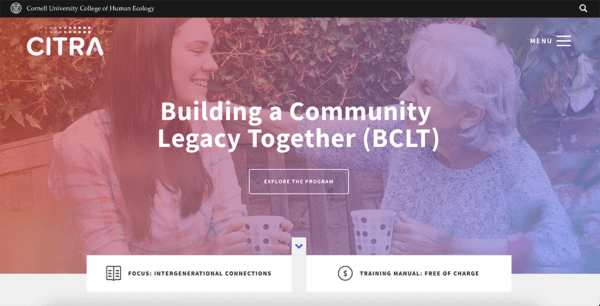
A screen capture of the BCLT website.
The program, Building a Community Legacy Together (BCLT), provides a structure for high school students to conduct interviews with and learn from older people. The program is approved as part of the national 4-H curriculum.
Karl Pillemer, Professor of Gerontology in Medicine at Weill Cornell Medicine, first got the idea for BCLT while working on a book, “30 Lessons for Living,” that captures the wisdom of older adults.
“It’s like two interlocking pieces in a puzzle: Young people need guidance to navigate their lives and to improve their attitudes toward aging and older people, and older people feel the need for generativity, which is a desire to support younger generations,” Pillemer said. “This program addresses these two problems at once.”
For the study, Pillemer and his team recruited 93 middle and high school youth; 47 participated in the program, and 46 were placed in a control group (The control group had the opportunity to participate in the program after the study ended).
Those who participated in the program spent approximately 20 hours exploring their thoughts and feelings about older people and learning social science methods, including how to plan and conduct interviews and how to synthesize and summarize qualitative data. Then, they interviewed older people in their communities and presented what they learned to the group.
“It is important to prepare younger people because, in some ways, this program is about cross-cultural communication,” Pillemer explained. “Just putting older and younger people together without preparing younger people is unlikely to have benefits. Younger people need to think about some stereotypes they may have and reflect on the value of older people in their lives.”
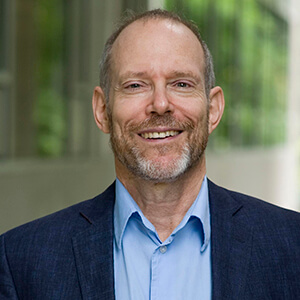
Karl Pillemer
Participants in the program reported significant improvements in their comfort and confidence interacting with older people, their attitudes toward older people, their interest in working with older people, and their own purpose in life. Researchers also found the program improved participants’ self-esteem, but not by a statistically significant amount.
In addition, nearly all the youth participants reported the program was a positive experience. They appreciated “hearing their ideas about how to deal with challenges in life” and “gaining advice from someone who has actually lived through life.” Although researchers did not report outcomes for the older adult participants, they also rated the program highly, Pillemer said.
Empowering older adults is an important aspect of the BCLT program according to Pillemer, who is Hazel E. Reed Professor in the Department of Psychology.
“In asking older people for advice, the young people are approaching them with a need,” he said. “That is very different than other programs where the young person is volunteering and the older person is needy. Our program empowers the older participants by putting them in the position of offering useful advice for living, based on their long experience.”
Programs like BCLT that connect older and young people in meaningful ways are essential in our aging society, Pillemer added.
“We are in the midst of what I consider to be a dangerous experiment, in which youth have almost no interactions with older individuals other than their own family members. We’re living in a society highly segregated by age, and that leads to stereotypes and misconceptions about aging. As our society ages, having young people develop relationships with older people is important. The BCLT program is an example of how this type of integrational approach can be rigorously tested and shown to be effective.”
You can learn more about BCLT and find all of the program materials at the Cornell Institute for Translational Research on Aging (CITRA) web site.