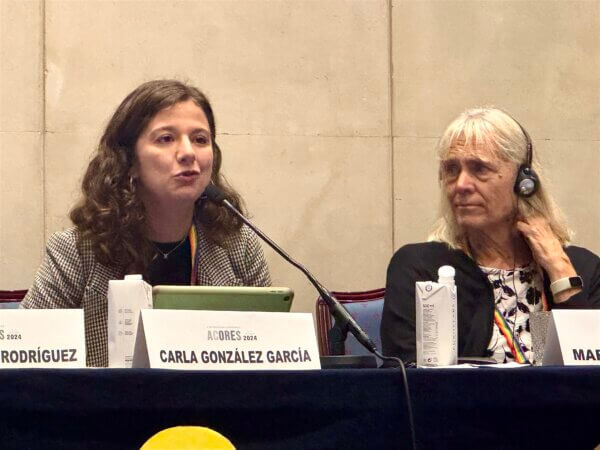
Martha Holden (right), director of the Residential Child Care Project, listens to Carla Gónzalez-García from the University of Oviedo speak at the ACORES II Conference in Oviedo, Spain. (Photo credit: Juan Vazquez-Leddon)
The Residential Child Care Project (RCCP), which helps organizations create conditions where children can heal with help from understanding adults, is implementing its evidence-based Children and Residential Experiences: Creating Conditions for Change – or CARE – model in Cantabria, Spain.
The CARE model provides residential care organizations with a framework for practice based on a valid theory of how children develop. It motivates children and staff to adhere to routines, structures and processes while minimizing the potential for interpersonal conflict.
“The children start to think differently and have different perceptions about the adults in their lives and how adults will respond to them,” said Martha Holden, senior extension associate in the Bronfenbrenner Center for Translational Research and director of RCCP. “They’ll see someone is on their side, someone who can help them, someone they can trust. It has a positive impact on their care.”
The CARE model was developed by the RCCP in collaboration with a group of experts, practitioners and community partners in 2005-2007. It has been successfully implemented in organizations throughout the United States, Canada, Ireland and Australia, and the California Evidence-Based Clearinghouse for Child Welfare identified it as having promising research evidence.
Officials in Cantabria, an autonomous community and province in northern Spain, began working with RCCP in 2022 after the Cantabrian Parliament passed a law in 2010 guaranteeing rights and care for children and adolescents in the community.
“It’s been 23 years that we’ve been trying to change youth care in Cantabria,” said José Ángel Rodríguez, a civil servant with the Government of Cantabria. “We’ve wanted to try something evidence-based for a long time.”
Rodríguez, Holden and colleagues shared the decision-making process and implementation effort at the ACORES II Conference, a global residential care conference held in Oviedo, Spain, in early October.
CARE is based on six evidence-based principles related to attachment, trauma, resiliency and ecological theory. It takes four years to implement the model, with Cornell University consultants training and supporting staff to incorporate the principles into their work.
“We want the same thing for children in residential care that we want for our children,” said Holden. “We want them to have healthy relationships, do well in school, develop good social behavior and have good emotional and social functioning.”
Children achieve those outcomes when they experience adults as trustworthy and working in their best interests, said Holden, which is why the model focuses on the organization and staff.
When establishing a new partner relationship, RCCP engages in a “co-learning and co-creation” strategy with a local implementation group or local partners who will work with the childcare agencies to implement the CARE model.
“RCCP is coming with expertise in CARE and how to implement it, but the local partners come with all the expertise about their organization, how they care for children, and their mission,” said Holden. “We have to marry those two together to end up with the positive outcomes that we both want.”
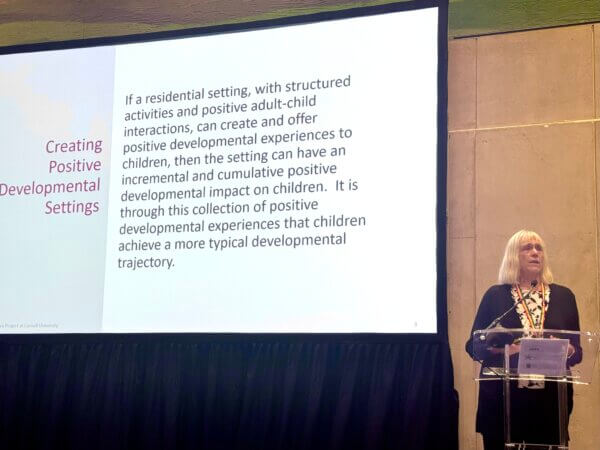
Martha Holden gives her presentation on the CARE model at the ACORES II Conference in Oviedo, Spain. (Photo Credit: Juan Vazquez-Leddon)
In Cantabria, RCCP’s local partners include the Government of Cantabria, two child welfare nonprofits, a charter school in the capital city of Santander, and several other residential programs.
To start, RCCP and the local partners visit the agencies that are involved in the CARE implementation. There are 13 agencies involved in Cantabria; seven will implement the CARE model and six will be the control group.
The Cantabria implementation is 18 months along, and the RCCP team is working with the University of Oviedo to collect data and ensure the program is working.
“The constant data collection helps decide support functions and also understand what young people are feeling and thinking,” said Carla Gónzalez-García, a researcher at the University of Oviedo. “That data can help us foster change.”
Luis Elías, who works with partner organization Fundación Diagrama, said agency staff have shifted to understanding the emotional needs of the children and how to meet those needs.
“We start thinking about what is happening to the child instead of what the child is doing,” he said. “With this change in mindset, the staff does things differently, the kids respond differently, and you get the changes you desire.”
The data also shows children viewing the adults in a different light – as helpful and not adversaries, even when a behavioral issue may arise.
“They used to perceive the staff as being cops, but that has changed,” said Desirée San Emeterio with the Guardian Angels School.
The Cantabria implementation group and RCCP are pleased with the progress so far, and with two and half years left to fully implement CARE, more work is still left to be done. It’s a long process and there was initial trepidation from the group due to how long it would take. Ultimately, they realized that working with RCCP has been a worthwhile effort.
“It’s not only a model for living. It’s a model for being with other people,” said San Emeterio.
A model, originating in Ithaca, that has been improving the lives of children around the world.