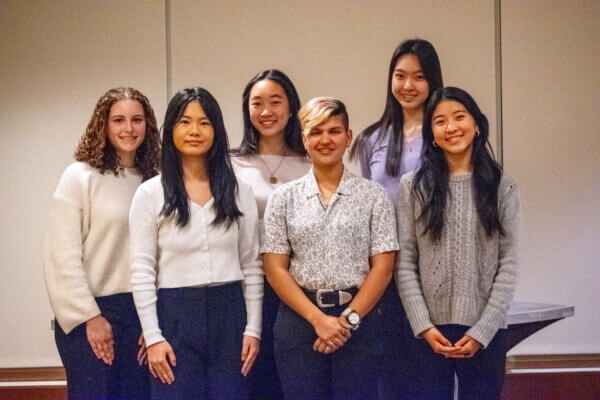
The 2025 BCTR Scholars are (l-r): Ilyssa Shapiro ’26, Celeste Zhang ’27, Mayah Chen ’28, Mack Dishmon ’27, Lorie Li ’28, and Madeline Lee ’28.
The Bronfenbrenner Center for Translational Research (BCTR) is excited to welcome its second cohort of BCTR Scholars, who will begin the program in the Spring 2025 semester. The BCTR Scholars program introduces Cornell Human Ecology students to translational research, which connects researchers, practitioners, policymakers, and community members to produce impactful research and implement findings through policies and programs. Students will apply what they learn during the program by working with community partners over the summer.
The 2025 BCTR Scholars are:
- Mayah Chen ‘28, Human Development
- Mack Dishmon ‘27, Human Development
- Madeline Lee ’28, Human Development
- Lorie Li ’28, Human Development
- Ilyssa Shapiro ’26, Human Biology, Health and Society
- Celeste Zhang ’27, Human Biology, Health and Society
The one-year BCTR Scholars program runs from January to December. During this time, students will learn the fundamentals of translational research and how it can help address pressing societal and community challenges. The program includes courses led by BCTR faculty and researchers.
“This is an outstanding cohort of students who are eager to learn how translational research can improve our communities,” said Carley Robinson, BCTR program coordinator.
In the spring semester, scholars will take two required courses. Over the summer, they will apply their knowledge through paid work with one of three community partners in Ithaca:
- Civic Ensemble: A theater organization that explores current social, political, and cultural issues.
- Village at Ithaca: An advocacy group promoting educational equity and excellence for underserved students in Tompkins County.
- Cayuga Health Center for Health Equity Transformation: A new center launched in October with a mission to eliminate health disparities in Cayuga Health’s service area.
“We’re thrilled to partner with these organizations, which are pillars of community service in the region,” Robinson said. “Our previous scholars have forged meaningful relationships with these partners, and we look forward to how to further these relationships with our new scholars this summer.”
In the fall semester, students will take a third course and present their research findings to the BCTR and community stakeholders.