
Earth Day this year spotlighted the efforts of Harvest New York, Cornell University Cooperative Extension – New York City (CUCE-NYC), and the Tree of Life Center Partnership (TOLCP) with the celebratory opening of the Tree of Life Community Garden in Jamaica, Queens. While the idea of a community garden and urban agriculture demonstration site in Jamaica was seeded years ago, conversation and collaborative efforts made it a reality. Kwesi Joseph and Karen Guzman, urban gardens specialists with Harvest NY, co-designed and co-led the implementation of the garden.
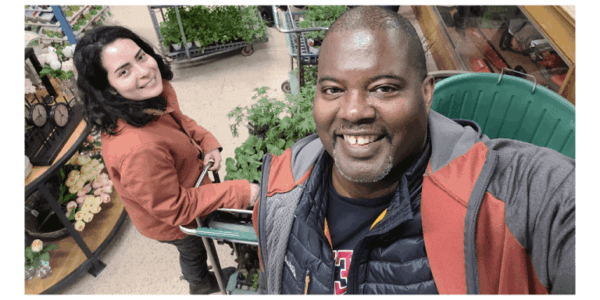
Karen Guzman (left) and Kwesi Joseph purchasing materials for the garden. (Photo provided)
The first attempt, in 2009, attempted to create a small in-ground garden at First Presbyterian Church in Jamaica (FPCJ). CUCE-NYC Queens/Brooklyn Community Nutrition Educators grew and harvested callaloo, tomatoes, collards, and herbs that were used in recipes for team gatherings, but soil contamination halted the growing of crops; yet the seeds of communal growing had been sown.
With funding support from the New York State Department of Agriculture & Markets and CUCE-NYC, the current garden uses modular raised beds with nutrient-dense soil to address soil contamination and other nutrient deficiencies. Attendees at the opening enjoyed vegetable and herb seedlings and walked through rows of leafy greens, including arugula, collards, kale, lettuce, plus brassicas such as broccoli, which was interplanted with onions and fragrant herbs, like cilantro and rosemary. Companion planting was used to optimize planting space to encourage biodiversity and beneficial insects and as a method of integrated pest management (IPM), drawing upon permaculture principles. Raised garden bed signage identified crops and provided nutritional guidance and recipes. Strawberries, as perennial plants, will remain in the garden, while warm-weather crops, like tomatoes, will soon replace vegetables such as lettuce. Future garden enhancements include the construction of additional raised beds and a drip irrigation system.
The Tree of Life Community Garden will serve as an educational demonstration site where community members, including First Presbyterian patrons and Tree of Life Center residents, can learn and grow food together. CUCE-NYC Community Nutrition Educators also will be able to use the garden’s crops for nutrition workshops. Rev. Patrick O’Connor, lead pastor at First Presbyterian, saw the garden as “a place of peace and [would] contribute to our health.”
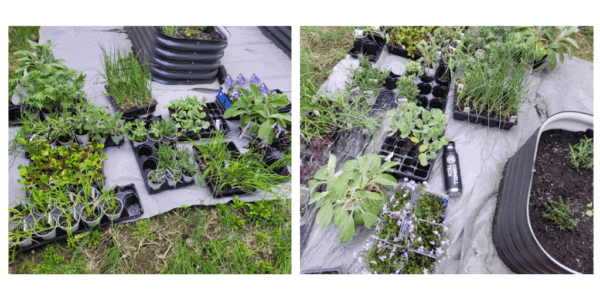
Vegetable seedlings, herbs, and other plants were available to participants at no cost. (Photo provided)
Qiana Mickie, executive director of the New York City Mayor’s Office of Urban Agriculture, attended the opening and emphasized the communal nature of gardening and the importance of community-driven spaces.
“Food connects us. Soil connects us – partnerships, community members, and church residents,” Mickie said.
The partnership between Cornell University Cooperative Extension – NYC and First Presbyterian Church in Jamaica exemplifies this as it has evolved and grown to meet community needs in housing, health, and nutrition. In 2022, First Presbyterian Church in Jamaica, First Jamaica Community and Urban Development Corporation (FJCUDC), the Community Health Network (CHN), the Queens Public Library, and Cornell University Cooperative Extension – NYC formed the Tree of Life Center Partnership (TOLCP). The mission of the TOLCP is to build a healthier Jamaica, Queens through the formation of a community resource hub, providing affordable housing, a full-service health facility, and other community assets. As the partnership evolves to meet the changing needs of Jamaica residents, the TOLC continues to bring in new partners. In 2023, the TOLCP welcomed the Queens Cancer Services Program, which conducts free breast, cervical, and colorectal cancer screenings, and the Jamaica Older Adults Center/Queens Community House, which provides activities for seniors at the center.
As New York State’s land-grant institution, Cornell University is committed to advancing the lives and livelihoods of New York State residents through initiatives, such as community-engaged learning opportunities, research projects, and extension programs. Cornell Cooperative Extension (CCE) addresses food security, health and nutrition, and urban agriculture, in addition to other program areas in New York City. Addressing the dynamic challenges of state residents also creates opportunities for collaborative integration among CCE NYC programs. For example, from 2022-2023, CUCE-NYC, Harvest NY, and the Action Research Collaborative (ARC) partnered together to implement an adapted version of the Expanded Food and Nutrition Education Program (EFNEP) to include a gardening component for families living in transitional housing at the Salvation Army Springfield Residence in Jamaica, NY.
Joseph pointed to the implementation of the garden at the Springfield Residence as a demonstration of “what was possible” when an interdisciplinary cross-program approach is taken.
“The TOL Community Garden continues and expands that partnership,” Joseph said. “As a graduate of York College, it means a lot to return and give back to the people of Jamaica, Queens through this work.”
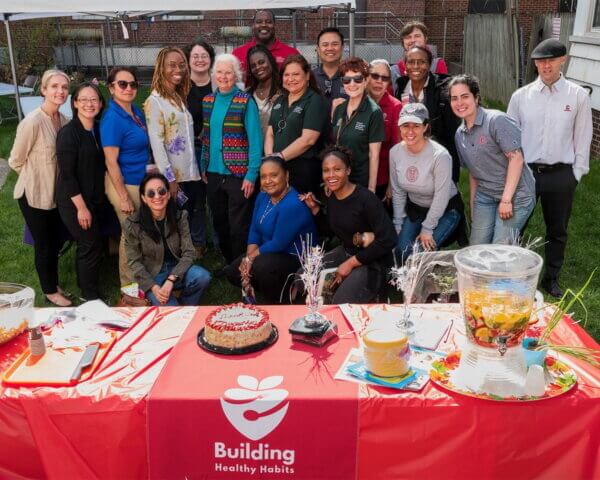
CUCE-NYC and Harvest NY team members at the Tree of Life Community Garden opening. (Photo provided)
Also recognizing the success of this interdisciplinary partnership and building on this working relationship between CUCE-NYC and Harvest NY, Jennifer S. Tiffany, recently retired executive director of CUCE-NYC, enlisted the assistance of Harvest NY to further the mission of the TOLCP with the prospects of a garden at the Tree of Life Center. During the celebration, Tiffany emphasized that partnership builds hope and encouraged attendees to “keep building hope, keep building partnership.”
The Tree of Life Community Garden demonstrates that a bountiful harvest can be had through an iterative, community-driven partnership development and building process.