The Bronfenbrenner Center for Translational Research concluded its Talks at Twelve Series for the spring semester with Marlen Z. Gonzalez, assistant professor of psychology at Cornell Human Ecology and director of the Community Neuroscience Initiative (CNI) and the Life History Lab.
“You usually don’t hear the words community and neuroscience together,” Gonzlaez began. “I think this is a shame because without [our brains] we wouldn’t be able to have community.”
Gonzalez discussed how neuroscience is a powerful tool used to understand the brain and make better choices, and why democratizing neuroscience – making it accessible to all – is key to helping all communities, specifically in reversing inequality. Gonzalez pointed to evidence that poverty and mental health do affect the brain, but that brains and people are also remarkably resilient and have agency.
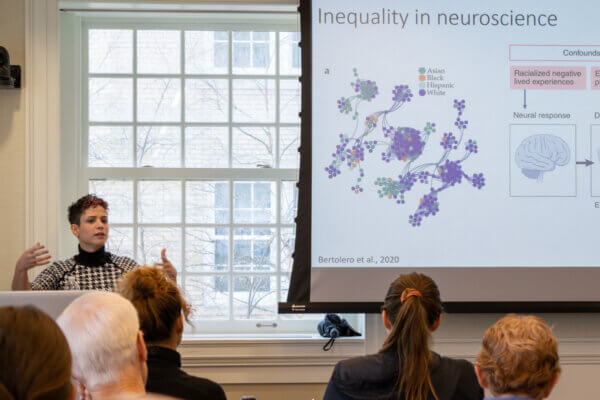
Marlen Z. Gonzalez, director of the Community Neuroscience Initiative and assistant professor of psychology at Cornell Human Ecology, gives a primer into Community Neuroscience during the Talks at Twelve on Apr. 20, 2023. (Photo credit: Juan Vazquez-Leddon)
“The skills you need in an affluent context and the skills you need in a context where you have disparity are different; and, of course, the nervous system is going to be different,” Gonzalez said.
But Gonzalez felt this evidence doesn’t address the root causes of inequalities. Throughout her graduate studies at the University of Virginia, she observed inequalities in neuroscience practices. For example, many research studies fail to report demographic data, often excluding entire populations, and research tools, like electroencephalograms, are less reliable when used for people of color who have thick and textured hair. This makes neuroscience less dependable, especially when applying insights to underrepresented or minoritized communities.
At Cornell, Gonzalez feels a responsibility to address the inequalities of neuroscience. She is working to democratize neuroscience as director of the Community Neuroscience Initiative. Founded in January 2022, CNI’s mission is to democratize neuroscience. To Gonzalez, this means making it accessible, translational, and inclusive.
“A democratized neuroscience is one that speaks to people with minimal jargon, applies to [people’s] lived experiences, and destigmatizes mental illness and neurodiversity” she explained.
Through CNI, Gonzalez brings neuroscience to communities, working with teachers and students to lead engaging neuroscience lessons for youth. In Syracuse, CNI offers a program called ‘Brain Days,’ where children can explore neuroscience and the way their brains impact their everyday lives. While most people are not exposed to neuroscience concepts until college, Brain Days is an intervention that reaches youth to help them understand perception, self-regulation, and emotions in prime developmental phases. Having programs like this in Syracuse is important, Gonzalez said, because bringing neuroeducation to youth also encourages them to see themselves as neuroscientists, which is critical in CNI’s mission to further diversify the field of neuroscience, and in turn, build a strong and inclusive neurocommunity.
Watch the full talk, “What is Community Neuroscience” here.