An essential part of the BCTR Scholars program is the summer experience working with Ithaca-area community partners. This is where students apply the translational research knowledge they gained during their spring semester class to a community-engaged research project with their partner organization.
This year’s partners include Civic Ensemble, a community-based theater company that creates work on pressing social issues; Cayuga Health’s Center for Health Equity Transformation (CHET), which works to reduce health disparities across the health system and community; and Village at Ithaca, a nonprofit that advances equity in local schools and the wider community.
The BCTR Scholars kept written reflections over the course of the summer. In them, they highlighted their work and recorded their thoughts on spending the summer in Ithaca, some of them living on their own for the first time. The following are some of their reflections from their summer of community-engaged work.
Ava Betnar ’29 and Sumaswara Chinthalapati ‘27 assisted Civic Ensemble with their shows on unions and housing insecurity.
Ava Betnar
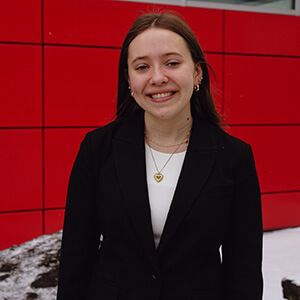 Suma and I were able to use translational research to support and evaluate Civic Ensemble’s community-based theatre productions, specifically a community-based play on housing insecurity in Tompkins County. We developed a thematic coding process for over ten hours of interview transcripts of Civic Ensemble speaking with various community members. The coding helped streamline and organize the playbuilding process. Additionally, we created audience experience evaluation surveys for “Cafe Utopia,” a play that explored inequitable workplace environments and the tools workers have to leverage power in a capitalistic system.
Working in a community-based arts setting was an enlightening experience. I was a little nervous about how well I’d be able to support Civic Ensemble because I wasn’t super familiar with theatre and the arts. However, I found that being curious and asking questions was the best way to serve the organization. Navigating new perspectives and ideas surrounding the arts and storytelling provided me with valuable insights into how art can be used to both drive positive changes in our communities and promote well-being. Specifically, I’ve come to recognize the importance of bridging the arts with research as art reminds us of the people behind the numbers.
Sumaswara Chinthalapati
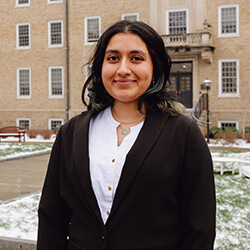 I think my goals for this experience changed throughout the summer. I started the internship thinking it would be very logistics-heavy, with a lot of data coding, logic model building and similar tasks. However, there was also a lot of hands-on experience and community engagement, which I was thrilled to be a part of. If I could continue working on this project, I would love to take a deeper dive into how community-based theatre and engagement can help raise awareness about important social issues.
Hearing about the different experiences with housing insecurity within the local Ithaca community was extremely eye-opening. I learned that there are many different levels of housing insecurity, from not having a permanent place to live to having housing that is unsafe or inadequate. Every experience is unique and equally valuable, especially when creating community-engaged theater that aims to accurately represent and raise awareness about local issues.
Fabiola Philbert ’28 and Enrico Hernandez ’28 partnered with CHET as social resource navigators, connecting patients with community resources.
Fabiola Philbert
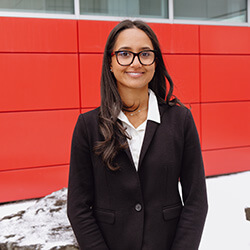 At first, the work that came with the social resource navigator role was very overwhelming. I had to become familiar with resources available in Tompkins County and then speak with a patient and determine what resources could be helpful to them. However, after my first week, I started to get the hang of things, and everything was coming more naturally. I learned that CHET is very well connected not only in Tompkins County but also in the surrounding areas. I also learned that everything at CHET is ever evolving, which I really appreciate, because they are constantly trying to improve the databases we work with and workflows we follow.
I am in community with my supervisors and my fellow interns. We communicate a lot – I speak with my supervisors every day, and we have weekly group meetings. Given that our work is remote, this helps build a sense of community. In the broader sense, the work I have been doing has been to serve the broader Ithaca community. The work my group and I do is very much community based and community focused, and the point of the research I’ll be doing based on my work is that it’s community informed. I really enjoy this, especially working with people in Ithaca. It motivates me to keep doing what I am doing, knowing that I am helping real people in a real way and the fact that the people I am helping are living in the same town as me.
Enrico Hernandez
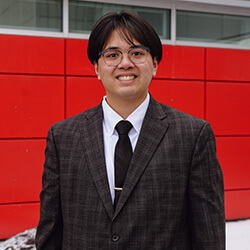 I find it really fulfilling when I can connect [patients] with resources. Working with Cayuga Health’s Center for Health Equity Transformation, I learned that they do a lot of social care navigation work and community engagement by identifying community resources and connecting patients with those resources. I expect to continue doing this work, and for my final deliverable, my co-BCTR scholar and I will be working on a risk stratification strategy for CHET. I hope to get used to patient communication and become better and more confident at it.
I did learn a lot from the patients I was speaking with. I learned the importance of using the right wording when talking about social drivers of health to be sensitive and concise. Different perspectives contribute to the success of the project because they allow me to identify gaps in my project, develop robust solutions and improve my work enjoyability. Engaging with different perspectives is important, even if uncomfortable, because it allows everyone to equitably contribute to the project and develop quality deliverables.
Danielle Chen ’29 and Jinyu Xu ’28 partnered with Village at Ithaca, digging into school suspension data from local districts and talking with youth and parents to better understand the systemic factors behind educational inequities.
Danielle Chen
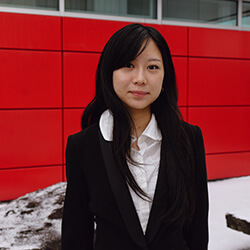 My first impression was how deeply [Village at Ithaca] connects with the families it serves. Village provides so many services, from food distribution to free housing, and they truly make a positive impact on these families’ lives. I also learned more about the research I’ll be doing this summer. I’m excited to work with data regarding school exclusion and create models that can benefit the Village. It is also especially motivating to know that our findings will be presented to the school district, where they could help inform future decisions in Ithaca schools. My hope for this summer is that my work will make a meaningful impact in the community!
Since starting with Village at Ithaca, I’ve been most excited about working within the community and building relationships with people. I expected to enjoy this part, but I didn’t realize how much I would learn from listening to others’ experiences. Getting to talk to people directly and learn from their lived experiences is truly different from just looking at statistics. Working with a community partner has met my expectations and shown me the importance of communication and adaptability, and this experience has made me want to bring a community-engaged perspective to my future work.
Jinyu Xu
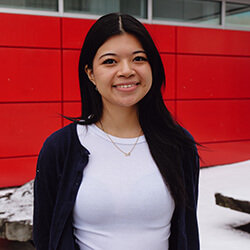 I found this position through the CHE newsletters and was inspired by the work the organization does for underserved children, particularly those who are facing or have faced school exclusion. Throughout the summer, I hope to learn more about systems of change theories and ways to evaluate programming. I am also excited to spend the summer in Ithaca and hope to enjoy nature!